
Text based on a speech delivered in a forum on ‘Innovate 4 Water’, organised by Waterpreneurs, Water Vent and the World Intellectual Property Organisation (WIPO) at the WIPO headquarters in Geneva on 9 June 2017
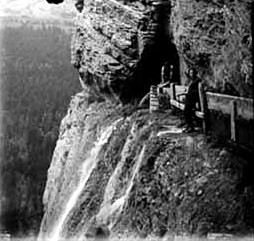
 Water for irrigation in the Swiss Alps
Water has a simple chemical formula – but is highly complex in nature, societal and economic context. The text below takes a brief view on one dimension, namely an economist’s view on global water challenges, including some facts that matter particularly from this perspective.
The first challenge is about access to safe drinking water.
- Let me start with the positive news: over the lasr 20 years, more than two billion people gained access to so-called improved drinking water sources[1].
- But this still leaves 750 million people without improved drinking water – and, worse, improved does not mean safe: according to Aquafed, some 2.6 billion people still rely on unsafe drinking water from standpipes, from trucks or from leaking pipes serving their homes. This last point is a reminder that we also talk about industrialised countries: leakage losses of drinking water are up to 30% in London (with pipes often 150 years old, the water company no longer tries to reduce the losses, but merely attempts to let the percentage not further increase), or 16% in the US[2]. Needless to say that leaks work both ways, i.e., drinking water does not necessarily maintain the quality when leaving the treatment pant once reaching households.
To change this situation would require huge amounts of investment. A few years ago, OECD estimated that more than one trillion USD annually are needed the for renewal of ageing infrastructure for water supply and wastewater collection. But actual spending is only about half of this amount, so infrastructure and as a result water quality keep deteriorating.
Another aspect is affordability. Municipal water supply organisations tend to cross-subsidise, they keep prices for tap water at home far below the cost of infrastructure. But this is money handed out to the more prosperous – 2.3 billion people without household connection often pay a multiple per cubic-metre of water of what the more prosperous have to pay.
This clearly shows: investment will not be enough; better politics and management will have to contribute to sorting this out.
The next challenge: to improve water quality by reducing pollution and eliminating dumping of untreated wastewater.
Actually, over 80% of wastewater is not collected or treated worldwide.[3] Contaminated water from inadequate wastewater management provides one the greatest health challenges restricting development.[4]
The third challenge: to substantially increase water-use efficiency across all sectors; to ensure sustainable withdrawals and supply of freshwater to address water scarcity; and substantially reduce the number of people suffering from water scarcity.
Again, this is about both developed and developing economies.
We can see the result of massive water overuse in some surface waterbodies: Aral Sea, lake Chad, rivers across the world that no longer reach the sea.
We can’t see, and this makes it even more dangerous, with the overuse of an increasing number of underground aquifers:
- Jakarta, New Orleans, Mexico City, Bangkok. In these cities, the excessive use of groundwater leads to subsidence, particularly a problem of urban settlements close to the sea.
- Rural Punjab: due to agricultural use of the water, the groundwater level goes down one meter per year. Farmers get the electricity to pump the water for free.
- One last example – Ogallala, the major source of groundwater in the US Mid West: today, withdrawals exceed natural renewal by more than 10% [5]
This last two examples concern regions that are among the main food baskets of the world.
And indeed, the main user are farms: about 70% of freshwater withdrawn worldwide goes to agriculture, used to grow our food. And a substantial part that increased massively in past years is used for biofuels – probably one of the most absurd initiatives supported by mandated and subsidies supposedly in favour of sustainability. As a reminder: farmers need about one litre of freshwater per calorie grown. But when looking at relative magnitudes of energy and food markets with respect to this measure: trying to grow enough corn and soy to replace only 5% of world energy by theses so-called biofuels would require the same amount of water as for the whole global food supply.
Without changing the way the world is using water today we risk shortfalls in global food production of up to 30% by 2030 as a result of water shortage; if we further increase the production of biofuels – with governmental subsidies and mandates – the extent of water shortage and its impact on the world will be even more severe.
The fourth challenge: address these issues in a relevant and cost-effective manner, and address these issues country-by-country, watershed-by-watershed. This sounds obvious, but is in very few places and instances actually applied. I might extend on that point on another occasion.
In summary: the water challenges I just outlined are bigger and more complex than many people think. The 2015 SDGs of the UN brought for the first time a comprehensive view on the different aspects. Here I refer in particular to the water goal (SDG 6) with its 8 targets. They provide a frame for governments to set priorities for their country, for their watersheds, since not everything is equally urgent and not everything can be done at once.
SDG 6 and other discussions show that there are valid responses to the water challenges just outlined, and other challenges not addressed above. And the list of participants of this event shows quite well that knowhow and the technology are there.
What is most important: we have to start the action now.
PS:
After my speech, in the discussion around coffee tables, the question came up how climate change relates to the major water challenges. So I looked this point up in the official documents of IPCC. The outcome is clear: as of today, the water problems are mainly caused by directly water-related policies and mistakes, as the three quotes below show:
“It should be noted that, using the per capita water availability indicator, climate change would appear to reduce overall water stress at the global level.”
http://www.ipcc.ch/pdf/technical-papers/ccw/chapter3.pdf page 45
“There is low confidence that anthropogenic climate change has affected the frequency and magnitude of fluvial floods on a global scale. The strength of the evidence is limited mainly by a lack of long-term records from unmanaged catchments. Moreover, floods are strongly influenced by many human activities impacting catchments, making the attribution of detected changes to climate change difficult. “
“There is low confidence in observed global-scale trends in droughts, due to lack of direct observations and due to geographical inconsistencies in drought trends. There is also low confidence in the attribution of changes in drought over global land areas since the mid-20th century, due to the same observational uncertainties and difficulties in distinguishing decadal scale variability in drought from long-term trends.”
http://www.ipcc.ch/pdf/assessment-report/ar5/syr/SYR_AR5_LONGERREPORT.pdf
Footnotes:
[1] http://www.who.int/mediacentre/news/releases/2012/drinking_water_20120306/en/
[2] https://www.epa.gov/sites/production/files/2015-04/documents/epa816f13002.pdf
[3] http://www.unwater.org/statistics/statistics-detail/fi/c/211793/
[4] http://www.unep.org/pdf/SickWater_screen.pdf
[5] https://www.washingtonpost.com/news/wonk/wp/2012/08/10/where-the-worlds-running-out-of-water-in-one-map/?utm_term=.5350c80d45d6

 ECONOMICS IN CONTEXT