
Perfect balance is at best a momentary and, therefore, transitional situation. Imbalances, are the much more frequent state and, can be a positive element (in economics, societies, nature, driving change, improvement and innovation. Before coming to my main point, i.e., present imbalances that may lead to major problems, let me give a few examples where imbalances may turn out to be a positive element:
- e.g., differences between wages for unqualified, qualified and highly qualified people, if not excessive, are stimulating individual investment in education (the time around 1980, when wage differentials in Europe were compressed by policy intervention, was then rightly seen as the period of Eurosclerosis);
- imbalances in trade are a sign of global economic dynamism and, therefore, a necessary (but obviously not sufficient) condition for global growth; no river flows if the country is perfectly flat, a world with all countries showing perfectly balanced foreign trade accounts would stagnate;
- imbalances from disruptive changes in technology, infrastructure, etc.
But there are indeed also imbalances that risk leading to turmoil, social and economic weakening and destabilisation.
Three major examples:
1. Imbalances in population growth:
Population growth worldwide, in Africa and the three selected countries sharing lake Chad (in million, source UN Population Division, 2012 forecast)
|
2015 |
2100 |
change |
| World |
7324.7 |
10853.8 |
+ 48% |
| Sub-Saharan Africa |
949.2 |
3815.6 |
+ 302% |
| Chad |
13.6 |
63.3 |
+ 365% |
| Nigeria |
183.5 |
913.8 |
+ 398% |
| Niger |
19.3 |
203.8 |
+ 956% |
This shows a situation that increasingly will become explosive, also for Europe (illegal immigration at a much higher scale than today). For the selection of countries in the table: they are all around Lake Chad, an aquifer that is drying up already today because of the overuse of water. Water shortage may turn out to become one of the biggest challenges for world societies and economy.
There are no easy solutions. The high population growth in Niger, for instance, happens despite the fact that since 2002 contraceptives have been provided free to all people in the country and radio programs promoting family planning have been launched.
2. Long-term youth unemployment
Unemployment rates of younger people across Europe often twice or even three times as high as average rates for all age groups. In the UK, for instance (a country with comparatively low unemployment in OECD Europe), people aged 15-25 are nearly three times more likely to be unemployed than the rest of the population, the largest gap in more than 20 years.[1]
|
Youth
unemployment |
Total
unemployment |
| Greece |
58.3 |
26.2 |
| Spain |
55.5 |
24.2 |
| Italy |
40 |
12.9 |
| Portugal |
38.1 |
13.5 |
| Slovakia |
33.6 |
13.1 |
| Ireland |
29.6 |
11 |
| Poland |
27.3 |
8.7 |
| Hungary |
26.6 |
7.6 |
| France |
23.9 |
9.7 |
| Sweden |
23.6 |
7.9 |
| EU |
23.5 |
10 |
| OECD – Total |
16.2 |
7.3 |
|
|
|
Source : OECD for 2013 and Q3 2014[2]
In many countries, these imbalances are directly related to labour market inflexibility, including minimum wages; labour market rigidities supposed to protect the weak actually hurt the most vulnerable and the new entrants, i.e., the young people. If these youngsters stay out of work for several years they risk never again entering a qualified job.
Inclusive growth is about opportunity, about getting a chance, and about the willingness to contribute to the common good.
“(Debate on) income inequality is a dangerous distraction from the real problems (that need to be addressed): poverty, lack of economic opportunity, and systemic injustice.” (CATO Institute)
3. Uncovered pension entitlements and other age-related costs
The elephant sitting on one side of the social balance of many countries today — rarely mentioned by politician who mainly think about reelection after a few years — are the longer term burden from uncovered pension entitlements and other age-related costs (the latter two-thirds of the total). These burdens are adding to private and public debt, with, as a consequence, rapidly increasing imbalances between generations and between different countries (also, but not only within Euro-Zone) over the next 25 years.
Below are charts with scenarios for the development of public debt influenced by uncovered age-related payment obligations in six OECD countries[3].
They were calculated and drawn up by the Bank for International Settlement, the central bank of central banks, and a main source for reliable international financial data.

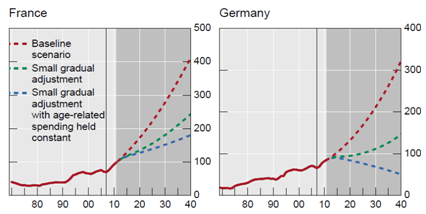

Red line scenario: baseline, countries continue with present policies.
Green line scenario: assuming that the primary balance of public accounts improves by 1 percentage point of GDP in each year for five years starting in 2012 (actual 2012-14: achieved in US, only about half of this rate of – modest – improvement was realised in the Eurozone)
Blue line scenario: freezing of all age-related spending-to-GDP at the level of 2011, i.e., a strategy leading to massive cuts in resources available per person to finance pensions, healthcare and homes.
The scenarios with an exploding debt up to 2040, and their assumptions, speak for themselves. The way politicians avoid to discuss them and take them seriously shows the state of our politics around the world.
Footnotes
[1] http://www.theguardian.com/society/2015/feb/22/youth-unemployment-jobless-figure
[2] https://data.oecd.org/unemp/youth-unemployment-rate.htm#indicator-chart
[3] http://www.bis.org/publ/work300.pdf


 ECONOMICS IN CONTEXT